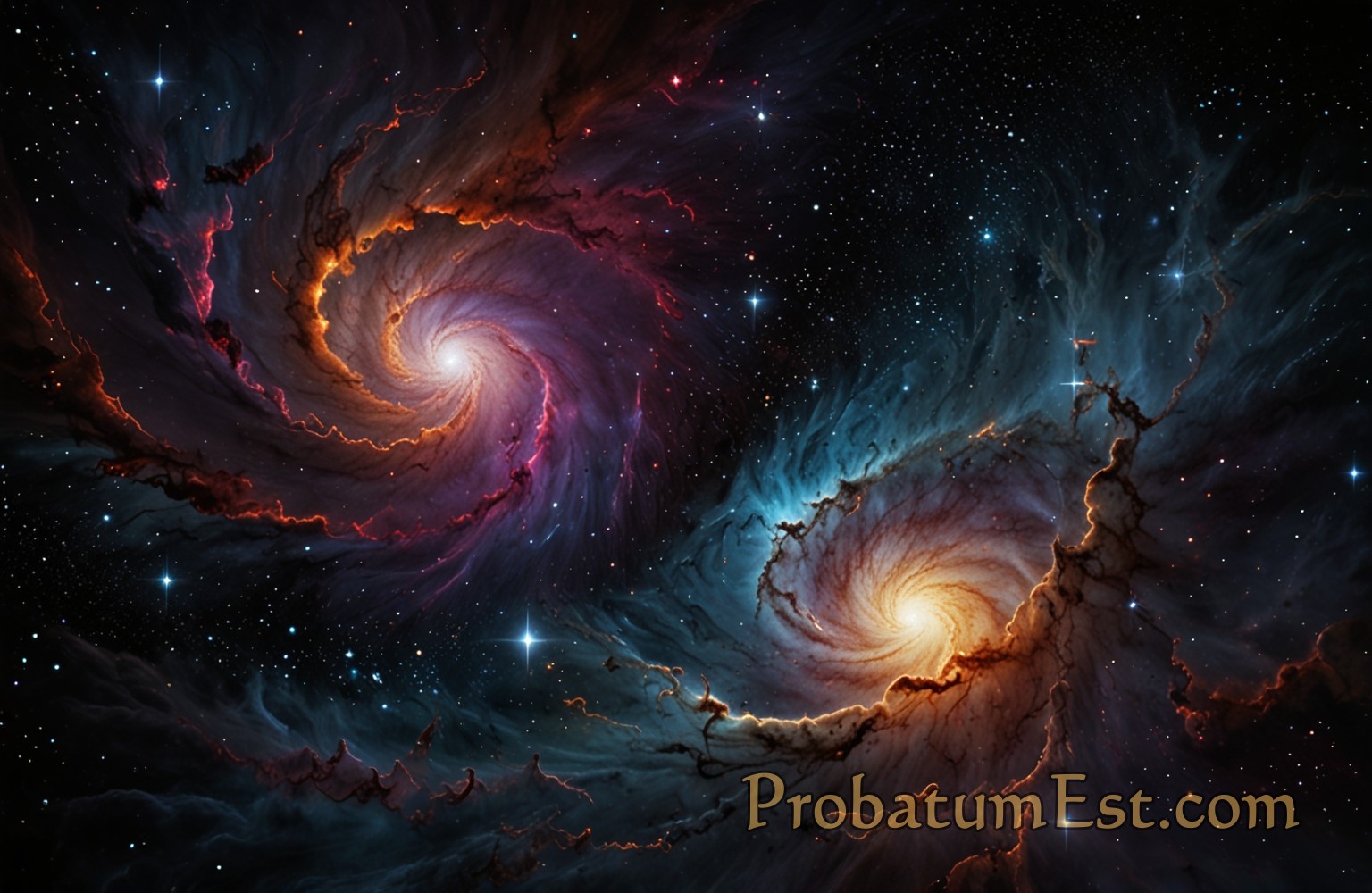
In the grand tapestry of the cosmos, dark energy stands as one of the most enigmatic and influential threads. It is a mysterious force that is believed to drive the accelerated expansion of the universe. While much remains unknown about dark energy, its discovery and the subsequent exploration have profoundly transformed our understanding of the universe. This article delves into the intricate world of dark energy, exploring its discovery, implications, and the ongoing quest to comprehend its nature.
Discovery and Evidence
The concept of dark energy emerged from observations conducted in the late 20th century. Prior to its discovery, the prevailing belief, grounded in the works of Edwin Hubble, was that the universe was expanding at a decelerating rate due to gravitational attraction. However, two independent teams—one led by Saul Perlmutter and the other by Brian Schmidt and Adam Riess—studying distant Type Ia supernovae, made a groundbreaking discovery in 1998. They observed that distant supernovae appeared dimmer than expected, indicating that instead of slowing down, the universe’s expansion was accelerating.
This startling revelation necessitated a new cosmic component: dark energy. Current estimates suggest that dark energy constitutes approximately 68% of the total energy density of the universe, overshadowing dark matter and ordinary baryonic matter.
Theoretical Perspectives
Various theoretical frameworks have been proposed to explain dark energy, though it remains an elusive concept:
- Cosmological Constant (\(\Lambda\)): One of the simplest explanations for dark energy originates from Einstein’s equations of General Relativity. Einstein initially introduced the cosmological constant to achieve a static universe model, but later discarded it after Hubble’s discovery of the expanding universe. In the modern context, the cosmological constant represents a constant energy density filling space homogeneously. It is mathematically elegant but raises questions about its exceedingly small but non-zero value, a problem known as the “fine-tuning problem.”
- Quintessence: Unlike the cosmological constant, quintessence is a dynamic field, akin to the scalar fields hypothesized in particle physics, that evolves over time and space. Models of quintessence allow the energy density to change, potentially offering a solution to the fine-tuning problem. However, introducing quintessence adds complexity and requires additional parameters to be constrained by observations.
- Modified Gravity Theories: Some physicists propose that modifications to General Relativity on cosmic scales could explain the observed acceleration without invoking dark energy. Theories such as f(R) gravity, braneworld models, and others attempt to tweak the gravitational interactions at large scales, but often struggle with reconciling deviations from General Relativity with observations within our solar system.
- Holographic Principle: Rooted in theoretical physics, the holographic principle suggests that the description of a volume of space can be encoded on its boundary. Some researchers argue that dark energy could be understood within this framework, although it remains a highly speculative avenue.
Observational Efforts
Significant strides have been made observationally to constrain the properties of dark energy and understand its role in cosmic evolution. Several large-scale surveys and observatories have contributed to this effort:
- Cosmic Microwave Background (CMB): Observations of the CMB, particularly from the Planck satellite, have provided precise measurements of the universe’s composition and the parameters governing its expansion, offering indirect insights into dark energy.
- Baryon Acoustic Oscillations (BAO): BAO measure the large-scale distribution of galaxies, acting as a “standard ruler” for cosmic distances. Surveys like the Sloan Digital Sky Survey (SDSS) have utilized BAO to trace the universe’s expansion history, shedding light on dark energy.
- High-Redshift Supernovae: Continuing the work that led to the initial discovery of dark energy, contemporary projects such as the Dark Energy Survey (DES) monitor thousands of supernovae to refine measurements of cosmic expansion.
- Gravitational Lensing: The bending of light due to massive objects, gravitational lensing also serves as a probe for dark energy. By studying how lensing alters the appearance of galaxies and galaxy clusters, researchers aim to decode the influences of dark energy on cosmic structures.
Implications and Challenges
The study of dark energy is not just an academic pursuit—it has profound implications for our understanding of fundamental physics and the ultimate fate of the universe. If dark energy continues to dominate, the universe could end in a “Big Freeze,” ever-expanding into colder and emptier vastness.
Nonetheless, challenges abound. The nature of dark energy remains a profound mystery, inherently tied to unresolved questions in fundamental physics, such as the unification of quantum mechanics and gravity. Additionally, the observational evidence, while robust, sometimes requires assumptions that introduce uncertainties.
Future Prospects
The quest to understand dark energy is ongoing, with several future missions poised to enhance our knowledge:
- Euclid Space Telescope: Launched by the European Space Agency, Euclid aims to map the geometry of the dark universe with unprecedented precision, focusing on dark energy and dark matter.
- Nancy Grace Roman Space Telescope: Previously known as WFIRST, this NASA mission is set to explore dark energy through multiple methods, including supernovae, BAO, and weak lensing.
- LSST (Legacy Survey of Space and Time): Conducted by the Vera Rubin Observatory, LSST will provide a dynamic map of the universe, offering insights into transient phenomena and large-scale structures.
Conclusion
Dark energy remains one of the most profound mysteries in modern astronomy, challenging our understanding of fundamental physics and the universe’s destiny. Through a combination of theoretical innovation and meticulous observation, scientists strive to unravel the secrets of this cosmic force. The journey is far from over, but each discovery along the way brings us closer to deciphering the true nature of dark energy and its role in the cosmos. As we probe deeper into the universe, we not only seek answers but also embrace the mysteries that continue to inspire and propel scientific inquiry.



Leave a Reply