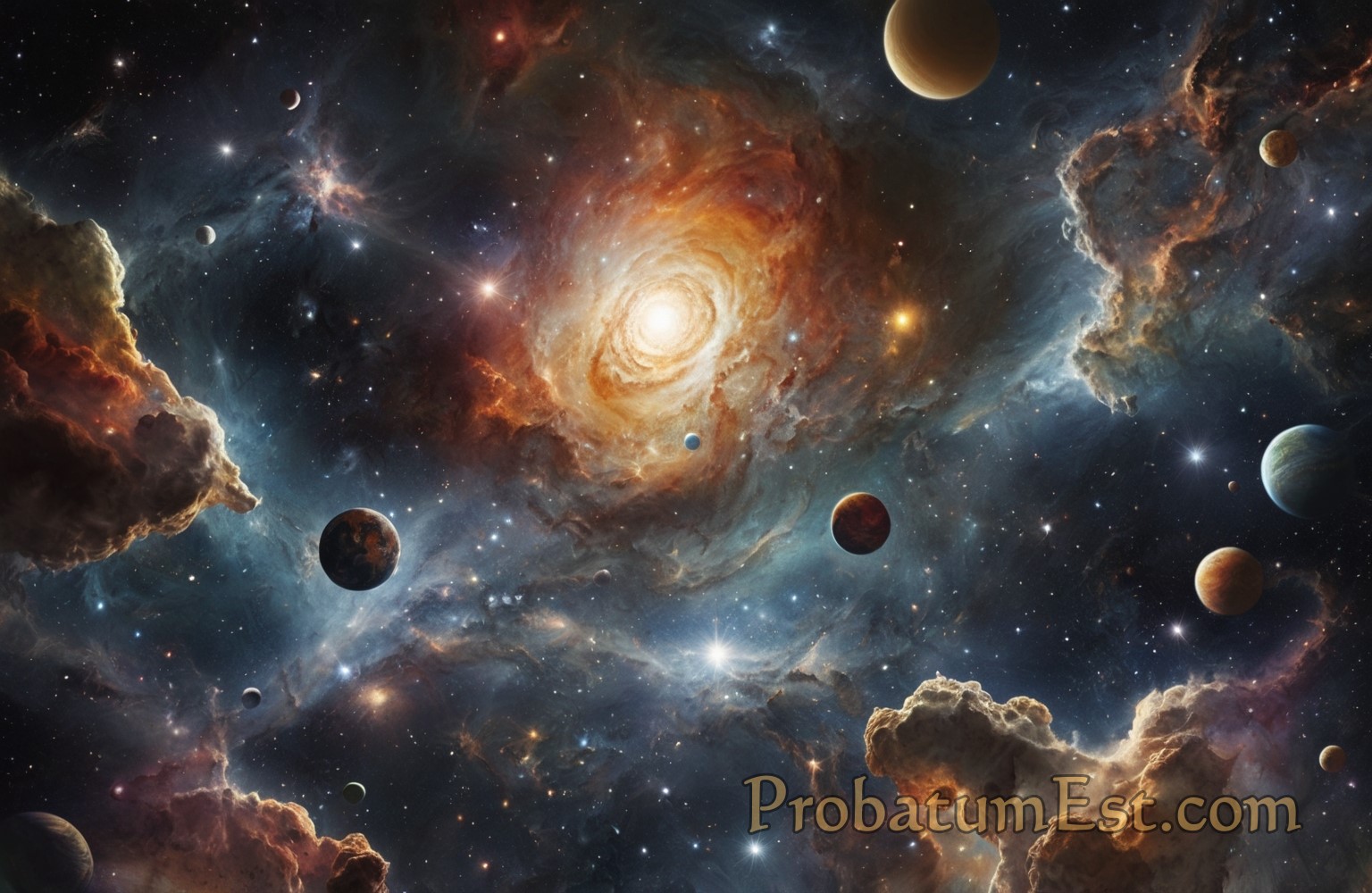
The cosmos, often synonymous with the universe, represents everything that exists: from the tiniest subatomic particles to the vast expanse of galaxies. This term is derived from the Greek word “kosmos,” which means order, reflecting the intricate and structured nature of the universe. From an astronomical perspective, understanding the cosmos involves investigating its origins, structure, components, and the fundamental laws that govern it. This exploration takes us on a journey through time and space, unveiling the mysteries of our existence.
Origins of the Cosmos
The Big Bang Theory
The prevailing model for the origin of the cosmos is the Big Bang theory. According to this theory, the universe began approximately 13.8 billion years ago from an infinitely small, hot, and dense singularity. This singularity expanded rapidly, leading to the formation of all energy and matter. The cosmic microwave background radiation (CMB), the afterglow of this monumental event, serves as a crucial piece of evidence supporting this theory.
Inflationary Universe
To address inconsistencies in the Big Bang model, such as the horizon and flatness problems, the inflationary universe theory was developed. Proposed by Alan Guth in the 1980s, this theory posits that the universe underwent an exponential expansion within the first fraction of a second after the Big Bang. This inflation smoothed out any initial irregularities, explaining the observed large-scale uniformity of the cosmos.
Structure of the Cosmos
Cosmic Web
The universe’s large-scale structure resembles a vast cosmic web consisting of filaments, voids, and nodes where galaxies cluster. These structures are the result of gravitational instabilities amplifying tiny quantum fluctuations during inflation. Galaxies reside along the filaments and congregate in clusters, with vast empty regions known as voids in between.
Galaxies
Galaxies are the fundamental building blocks of the cosmos and exist in various forms, such as spiral, elliptical, and irregular. Our galaxy, the Milky Way, is a barred spiral galaxy containing hundreds of billions of stars, along with nebulae, dust, and dark matter. Understanding galactic formation and evolution provides insights into cosmic chronology and the processes driving the cosmos.
Components of the Cosmos
Baryonic Matter
Baryonic matter consists of protons, neutrons, and electrons—the stuff that makes up stars, planets, and every living organism. Despite its significance in forming observable structures, baryonic matter accounts for only about 5% of the universe’s total content.
Dark Matter
Dark matter, comprising about 27% of the universe, is an elusive form of matter that does not emit or absorb electromagnetic radiation. Its presence is inferred from gravitational effects on visible matter. It plays a critical role in the formation and stability of cosmic structures by exerting additional gravitational forces.
Dark Energy
Dark energy is perhaps the most mysterious component of the cosmos, constituting about 68% of the universe. It is associated with the observed acceleration of the universe’s expansion. Various theories attempt to explain dark energy, with the cosmological constant, a concept originally introduced by Albert Einstein, being one of the leading candidates.
Fundamental Forces and Laws
Gravity
Gravity is the force responsible for the attraction between masses. It governs the movements of celestial bodies and the formation of cosmic structures. Isaac Newton’s law of universal gravitation and Albert Einstein’s theory of general relativity provide profound insights into understanding gravitational phenomena.
Electromagnetism and the Weak and Strong Nuclear Forces
Electromagnetism is the force responsible for electromagnetic radiation and governs atomic and molecular interactions. The weak nuclear force is responsible for processes like beta decay, while the strong nuclear force binds protons and neutrons in the atomic nucleus. Together with gravity, these three forces comprise the fundamental interactions in the universe.
Observing and Exploring the Cosmos
Telescopes and Observatories
Advancements in technology have significantly enhanced our ability to explore the cosmos. Ground-based telescopes like the Very Large Telescope (VLT) and space-based observatories like the Hubble Space Telescope have revolutionized our understanding, providing breathtaking images and invaluable data about celestial phenomena.
Gravitational Wave Astronomy
The detection of gravitational waves by observatories like LIGO and Virgo opened a new window into the universe. Gravitational waves are ripples in spacetime caused by cataclysmic events, such as the merging of black holes or neutron stars, offering insights into the most energetic processes in the cosmos.
Future Missions
Ongoing and future missions, such as the James Webb Space Telescope, promise deeper insights into the cosmos. They aim to explore the first galaxies, study the atmospheres of exoplanets, and investigate the nature of dark matter and dark energy, advancing our cosmic understanding.
The Expanding Universe
Hubble’s Law
Edward Hubble’s observations in the early 20th century revealed that galaxies are moving away from each other, indicating that the universe is expanding. Hubble’s Law establishes a relationship between the distance of a galaxy and its recessional velocity, providing a framework for measuring cosmic expansion.
Implications for the Future
The expansion of the universe raises questions about its ultimate fate. Models suggest scenarios such as continued expansion leading to a “Big Freeze,” a contraction resulting in a “Big Crunch,” or even a “Big Rip,” where cosmic structures break apart due to relentless expansion driven by dark energy.
Philosophical and Existential Considerations
The study of the cosmos also invites questions about our place in the universe. As we uncover more about the vastness, complexity, and beauty of the cosmos, we are reminded of our transitory existence and the interconnectedness of all matter and energy. The quest to understand the cosmos is as much a scientific endeavor as it is a philosophical journey, shaping our perception of reality and our place within the grand tapestry of existence.
In conclusion, the cosmos represents the totality of our universe, encompassing all that exists. It is a realm of endless discovery, wonder, and mystery. Through the lens of astronomy, we not only seek to understand the physical attributes of the cosmos but also engage in a timeless pursuit to comprehend our significance within this vast, extraordinary, and incredible expanse.

Leave a Reply