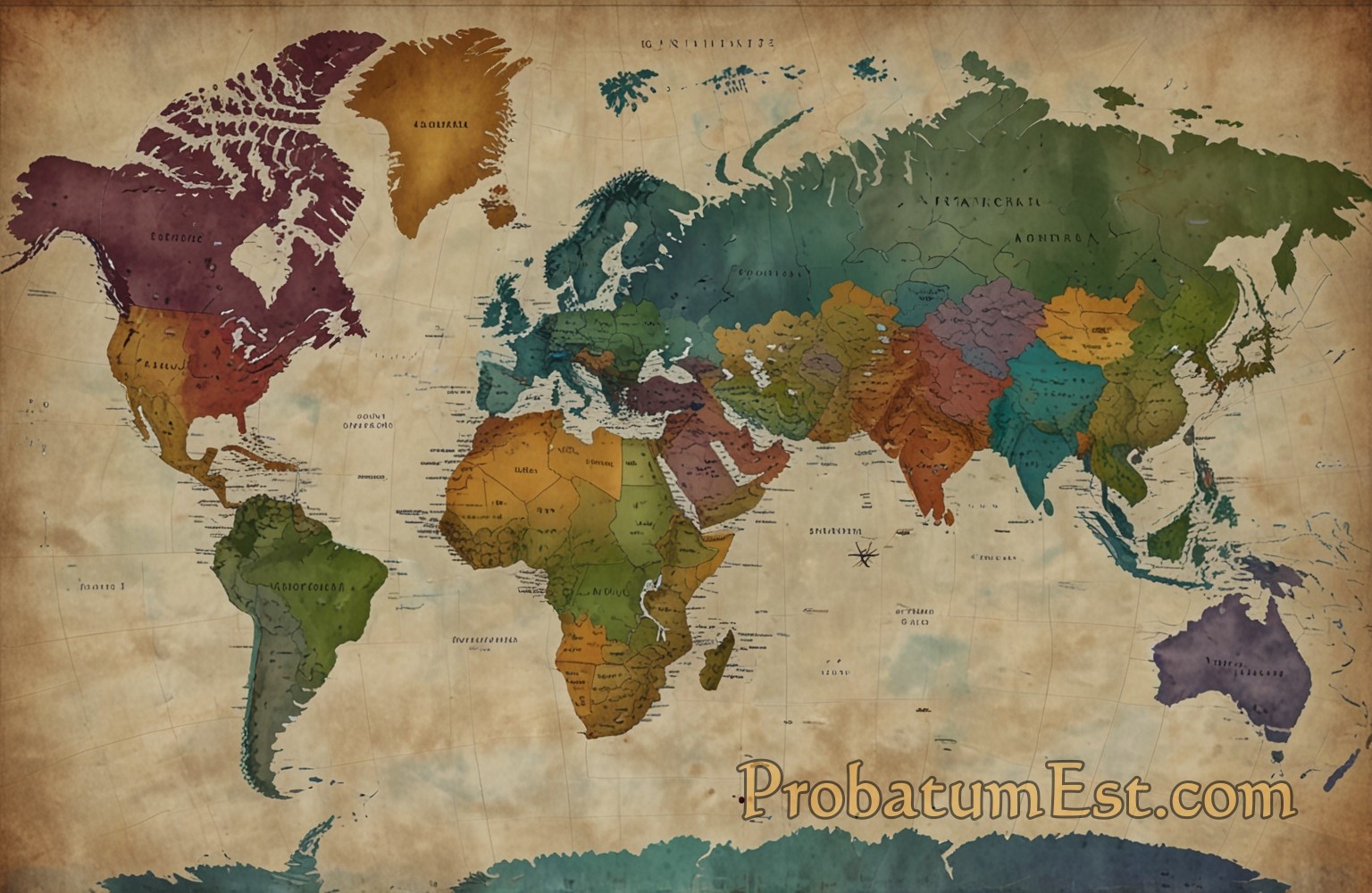
The concept of continents is a fundamental component in the discipline of geography, serving as a foundational pillar in the understanding of our world’s spatial divisions. While the basic idea of continents is familiar to many, the intricacies involved in defining and categorizing them reveal a complex tapestry of geological, cultural, and historical elements. This article delves deep into the framework of continents, examining their origins, definitions, and their significance in world geography.
Origins and Historical Perspectives
The word “continent” is derived from the Latin “terra continēns,” meaning “continuous land,” reflecting the early understanding of large, uninterrupted land expanses. Historically, the notion of continents emerged from early seafaring and exploration activities, where these land masses were identified based on exploration and cartography. Ancient Greeks like Herodotus and philosophers such as Strabo initially conceptualized three continent-system based on Europe, Asia, and Libya (Africa).
Over centuries, with the expansion of exploration, the number of recognized continents increased. By the Age of Enlightenment, the debates on how to define and categorize continental masses became intense as explorers discovered more landmasses previously unknown to Europeans.
Defining Continents
Defining a continent is not as straightforward as it might appear. Variations in geology, culture, and politics play significant roles in shaping different concepts of what constitutes a continent. Generally, continents are defined based on several criteria:
- Geological Definition: From a geological perspective, continents are large land masses of the Earth’s crust that rise above the ocean floor. These are typically defined by distinct geological plates. The Earth’s lithosphere is broken into tectonic plates, some of which contain continental land masses. For instance, the Eurasian Plate encompasses both Europe and Asia.
- Cultural and Historical Context: Continents can also be contextually defined based on cultural and historical factors. This includes a shared history, language roots, religious traditions, and cultural heritage which blur purely geographical boundaries. For instance, though Europe and Asia are part of the same land mass, they are often seen as separate continents due to their distinct cultural and historical identities.
- Political and Conventional Definitions: Politically, continents are often defined by agreement and convention. Different societies may categorize continents based on political boundaries or regional affiliations. For instance, geopolitical categorizations sometimes separate North and South America into different continents.
- Anomalous Cases: Unique cases, such as the island nation of Australia, challenge traditional continental definitions. Australia is frequently recognized as a continent due to its size and significant geological presence, serving as both a country and a continental mass.
The Seven-Continent Model
The most widely accepted model today divides the world into seven continents: Africa, Antarctica, Asia, Europe, North America, Australia (often referred to as Oceania when considering associated islands like New Zealand), and South America.
- Africa: Known for its vast diversity in terms of ecosystems and cultures, Africa spans from Mediterranean climates in the north to tropical rainforests in the west and deserts in the south. Geologically, the African Plate encompasses the continent and is bordered by the Eurasian Plate to the north.
- Antarctica: This icy expanse is governed by the Antarctic Treaty System, which emphasizes scientific exploration while prohibiting military activity. Unique in its geographical isolation and uninhabited nature, it provides vital data on global weather patterns and climate science.
- Asia: As the largest continent by both area and population, Asia showcases an immense range of environments, from the Middle Eastern deserts to the Siberian tundra. It is a cultural mosaic, home to many of the world’s oldest civilizations.
- Europe: Known for its historical and cultural influence worldwide, Europe’s borders with Asia are often debated. Traditionally, the Ural Mountains, Ural River, and the Caspian Sea mark the boundaries, though some consider political boundaries as more definitive.
- North America: This continent is characterized by its economic diversity and political influence. It includes vast natural resources and varied landscapes ranging from Arctic tundras to tropical Caribbean climates.
- Australia (Oceania): Often synonymous with Oceania in some educational paradigms, this continent is distinguished by its unique biodiversity and cultural heritage stemming from indigenous civilizations.
- South America: Known for its impactful history with colonial empires and rich cultural traditions ranging from the Andes to Amazonia, South America holds a variety of ecological zones and indigenous peoples.
Alternative Models
While the seven-continent model is prevalent in Europe and North America, other models exist:
- Six-Continent Model (Eurasia): Some countries, especially those in parts of Eastern Europe and Asia, teach a six-continent model where Europe and Asia are combined into a single continent called Eurasia.
- Six-Continent Model (America): In this system, including parts of Latin America, North and South America are combined into one continent, known simply as America.
- Five-Continent Olympic Rings Model: The interlocking rings symbolize the shared humanity across continents, although there are only five rings. This represents Africa, the Americas (combined), Asia, Europe, and Oceania.
Conclusion
Continents are more than just mere landmasses; they embody the interplay of geology, culture, history, and politics. As human understanding deepens and evolves, so too might the concepts dividing the Earth into continents. What remains consistent is the continents’ capacity to shape the identity of Earth’s inhabitants, supporting a diversity of life and fostering human civilization. The study of continents is therefore not just an exploration of physical geography but a journey through the shared and diverse experiences of humanity’s global tapestry.




Leave a Reply