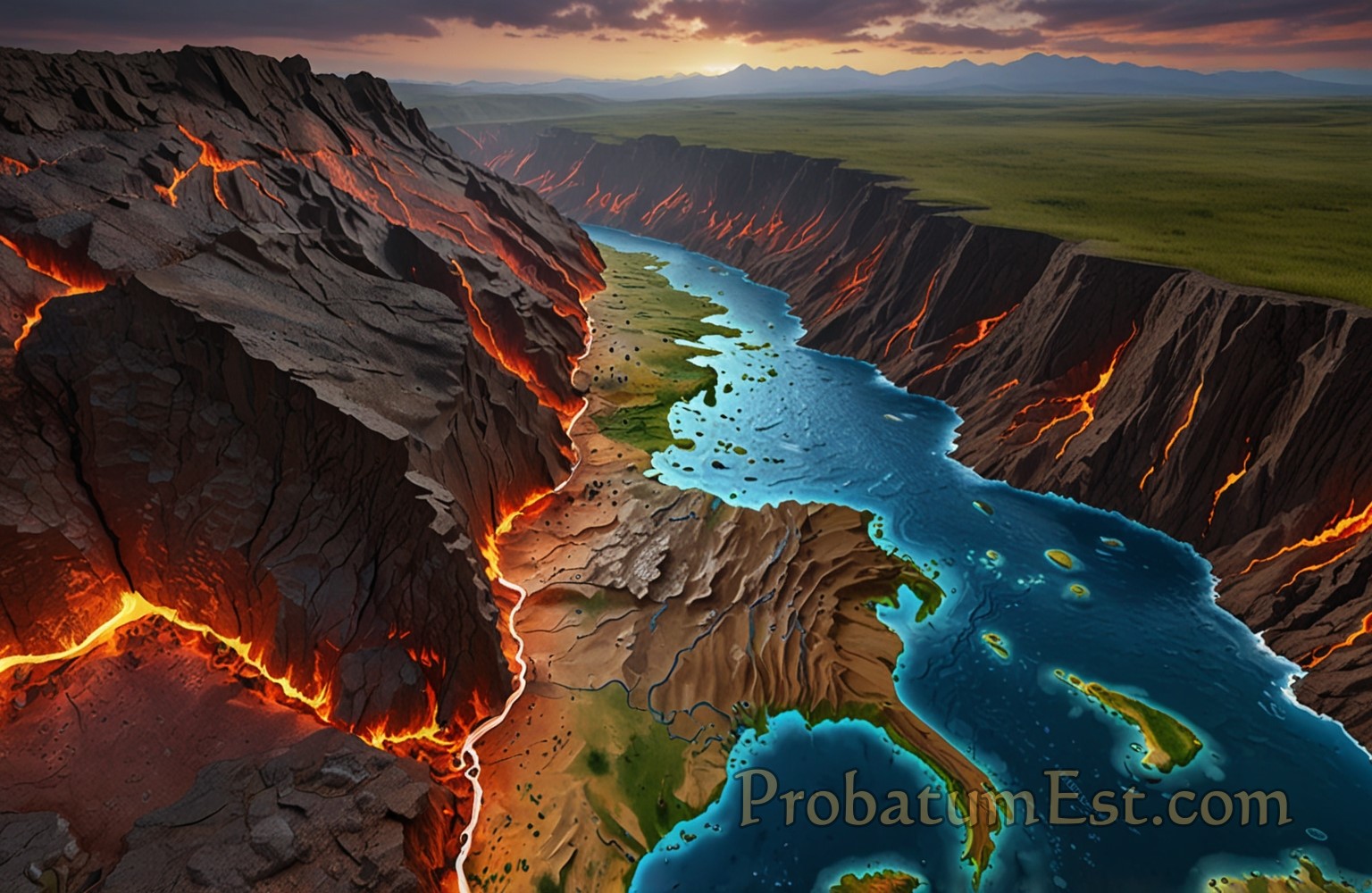
The surface of the Earth, while seemingly stable and solid, is in a constant state of flux. This is due to the planet’s outer shell, known as the lithosphere, which is divided into massive slabs of rock called Tectonic Plates. These plates not only shape the Earth’s landscape but also drive volcanic activity, earthquakes, and the creation of mountain ranges. This article delves into the intricate world of tectonic plates, exploring their nature, movements, interactions, and the profound influence they exert on the Earth’s geology.
The Structure of the Earth
Before diving into tectonic plates, it’s essential to understand the layers that make up the Earth:
- Crust: The outermost layer, it is composed of solid rocks and minerals. It is relatively thin compared to other layers, varying between 5 to 70 kilometers in thickness.
- Mantle: Beneath the crust lies the mantle, which extends to a depth of about 2,900 kilometers. It is composed of silicate minerals rich in iron and magnesium and is semi-viscous, allowing it to flow slowly.
- Core: Divided into the outer core and inner core, the outer core is liquid and made primarily of iron and nickel, while the inner core is solid due to immense pressure.
The lithosphere consists of the crust and the uppermost part of the mantle. This rigid layer is what the tectonic plates are made of.
The Theory of Plate Tectonics
The theory of plate tectonics is a relatively recent scientific advancement, established in the mid-20th century. It posits that the lithosphere is divided into several plates that float on the semi-fluid asthenosphere beneath them. This theory was born out of the earlier hypothesis of continental drift, proposed by Alfred Wegener, which suggested that continents were once a single landmass (Pangaea) and have since drifted apart.
Major Tectonic Plates
The Earth’s lithosphere is fragmented into several major plates, as well as numerous smaller ones. The primary tectonic plates include:
- Pacific Plate: The largest of all tectonic plates, mainly beneath the Pacific Ocean.
- North American Plate: Covers North America and parts of the Atlantic Ocean.
- Eurasian Plate: Encompasses Europe and Asia.
- African Plate: Covers the continent of Africa and parts of the Atlantic Ocean.
- Antarctic Plate: Encircles the continent of Antarctica.
- Indo-Australian Plate: Includes Australia, the Indian subcontinent, and the surrounding oceanic regions.
- South American Plate: Covers South America and parts of the Atlantic Ocean.
Plate Boundaries and Their Interactions
The interactions at the plate boundaries are a major source of geological activity. There are three primary types of plate boundaries:
1. Divergent Boundaries
Occur where two tectonic plates are moving apart. This typically happens at mid-ocean ridges, where new crust is generated through volcanic activity. The Mid-Atlantic Ridge is a prime example, where the North American and Eurasian plates are diverging.
2. Convergent Boundaries
Here, two plates move towards each other, often resulting in one plate being forced beneath the other in a process known as subduction. This can lead to the formation of mountain ranges, deep ocean trenches, and volcanic activity. The Andes mountain range in South America is a result of the Nazca Plate subducting beneath the South American Plate.
3. Transform Boundaries
At these boundaries, plates slide past one another horizontally. The stress that accumulates as the plates grind past each other can cause earthquakes. A famous example is the San Andreas Fault in California, where the Pacific Plate and North American Plate slide past each other.
Effects of Plate Tectonics
1. Earthquakes
Earthquakes are a direct result of movements at plate boundaries. As plates grind, collide, or pull apart, energy is released in the form of seismic waves, leading to the shaking of the Earth’s surface. The distribution of global earthquake activity aligns closely with plate boundaries.
2. Volcanoes
Most of the world’s volcanoes are located along divergent and convergent boundaries. At divergent boundaries, magma rises from below the crust to fill the gap, forming new crust. At convergent boundaries, subducted plate material melts, creating magma that can rise to the surface through volcanic eruptions.
3. Mountain Building
The collision and convergence of tectonic plates lead to the creation of mountain ranges. The Himalayas, the tallest mountains on Earth, were formed by the collision of the Indian and Eurasian plates.
4. Ocean Basin Formation
As plates diverge, new oceanic crust is formed, expanding ocean basins. This process is visible at the global mid-ocean ridge system.
The Driving Forces Behind Plate Tectonics
The movement of tectonic plates is driven by the heat from the Earth’s interior, creating convection currents in the mantle. These currents are thought to push and pull the plates across the planet’s surface. Other theories suggest mechanisms like slab pull, ridge push, and basal drag play roles in plate movements.
Conclusion
The theory of tectonic plates not only explains the dynamic nature of Earth’s surface but also offers insights into the past and future movements of continents and oceans. While much has been learned about tectonic processes, research continues to uncover the complexities of these enormous geological forces. Understanding tectonic plates is fundamental to our knowledge of the planet’s past, its current geological activity, and how these forces might shape its future. As our comprehension of these processes improves, so too does our ability to mitigate natural disasters and further our exploration of Earth’s boundless geological mysteries.



Leave a Reply