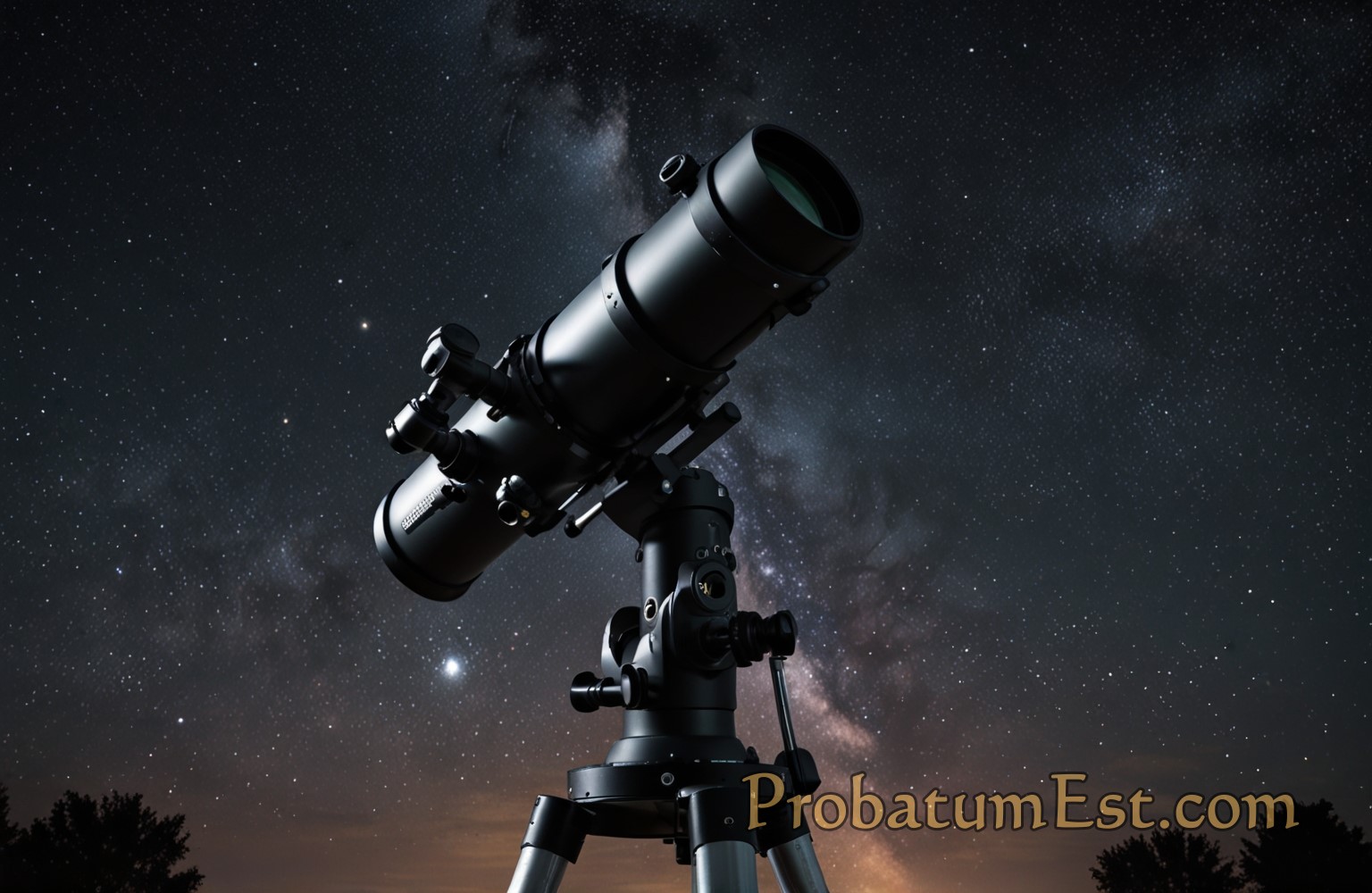
Telescopes have revolutionized our understanding of the cosmos since their inception in the early 17th century. As the fundamental instruments of observational astronomy, telescopes enable us to explore the vast universe beyond what the naked eye can perceive. This article delves into the intricacies of telescopic technology, its historical development, types, and significant contributions to the field of astronomy.
Historical Development
The telescope’s invention is attributed to Hans Lippershey, a Dutch eyeglass maker, in 1608. However, Galileo Galilei was among the first to use it for astronomical purposes in 1609. His observations revealed lunar craters, Jupiter’s moons, and the phases of Venus, challenging the geocentric models of the cosmos.
In the following centuries, significant advancements were made. Isaac Newton developed the first practical reflecting telescope in 1668, employing mirrors instead of lenses to avoid chromatic aberration. This innovation laid the foundation for modern telescopes.
Anatomy of a Telescope
Basic Components
- Objective Lens/Mirror: The primary component that gathers light. In refracting telescopes, this is a lens, while in reflecting telescopes, it’s a mirror.
- Eyepiece: Magnifies the image formed by the objective for the observer.
- Mount: A robust support structure allows precise alignment and tracking of celestial objects.
- Focal Length: Determines magnification and field of view. A longer focal length increases magnification.
Optical Quality
The optical quality of a telescope is crucial for resolving distant celestial objects. Key aspects include:
- Aperture: Width of the objective; a larger aperture gathers more light, enhancing image brightness and resolution.
- Resolution: Ability to distinguish close objects. It’s limited by the aperture size and atmospheric conditions (seeing).
- Magnification: Ratio of the telescope’s focal length to the eyepiece’s. High magnification reveals finer details but reduces brightness.
Types of Telescopes
Refracting Telescopes
Comprised of a set of lenses to bend light, refractors provide sharp images and are durable, as their lenses are mounted inside a sealed tube. They’re limited in aperture size due to lens fabrication challenges. Popular models, such as the classic achromatic and more advanced apochromatic refractors, are widely used for planetary and lunar observations.
Reflecting Telescopes
Designed with mirrors to collect light, reflectors can be constructed with larger apertures than refractors, thus enabling greater light collection and resolution. The Newtonian, Cassegrain, and Dobsonian configurations are notable examples. They are predominantly used for deep-sky observation due to their larger apertures.
Catadioptric Telescopes
Combining lenses and mirrors, these telescopes, like the Schmidt-Cassegrain and Maksutov-Cassegrain, offer compact, versatile designs apt for both planetary and deep-sky observations. They excel in portability and ease of use while maintaining good optical performance.
Telescope Mounts
The mount is crucial for stability and tracking:
- Altazimuth Mount: Simple, easy to use, offers two axes of movement (altitude and azimuth). Popular with casual observers.
- Equatorial Mount: Aligns with Earth’s rotation, allowing smooth tracking of celestial objects. It’s essential for long-exposure astrophotography.
- Go-To and Computerized Mounts: Automate tracking and object location using computer software, enhancing the user experience by guiding to predetermined celestial coordinates.
Significant Telescopes in History
Hubble Space Telescope
Launched in 1990, Hubble orbits Earth, free from atmospheric distortions, delivering unprecedented clarity. It has contributed immensely to our understanding of the universe, from the rate of expansion (Hubble constant) to the detailed imaging of far galaxies, star formations, and exoplanets.
Very Large Telescope
Located in Chile, the Very Large Telescope (VLT) is composed of four unit telescopes with 8.2-meter mirrors. Through advanced adaptive optics, it captures sharp, detailed astronomical data, contributing to studies on black holes, distant galaxies, and stellar formations.
James Webb Space Telescope
Scheduled for launch as a successor to Hubble, the James Webb Space Telescope (JWST) is designed to observe the universe in infrared, enabling the study of the cosmos’ earliest structures and chemical compositions.
Contribution to Astronomy
Telescopes have fundamentally shifted our understanding of the universe, confirming the heliocentric model and offering insights into cosmic phenomena. They’ve facilitated the discovery of thousands of exoplanets, the observation of supernovae, and the exploration of distant galaxies.
Atmospheric and Environmental Limitations
Ground-based telescopes suffer from atmospheric distortions. Advances like adaptive optics correct these in real time, enhancing resolution. Light pollution is another significant challenge, necessitating remote locations for observatories.
Future Innovations
The future of telescopic technology includes massive projects like the Giant Magellan Telescope and the Thirty Meter Telescope. These projects promise even greater clarity and depth, potentially unraveling more cosmic mysteries.
Conclusion
From the first observations of celestial bodies to modern explorations of deep space phenomena, telescopes have been pivotal in expanding our astronomical knowledge. As technology advances, telescopes will continue to shape our understanding of the universe, offering insights into the origins, structure, and future of all cosmic elements. They remain a testament to human curiosity and ingenuity, bridging the vast gulf between Earth and the cosmos.


Leave a Reply