The universe is a vast tapestry woven with countless celestial objects, each playing its unique role in the grand cosmic drama. From the fiery surface of our Sun to the mysterious black holes lurking in the depths of space, these entities offer a glimpse into the awe-inspiring complexity and beauty of the cosmos. This article aims to provide an in-depth exploration of the various types of celestial objects and their significance, unraveling the mysteries that lie beyond our earthly realm.
The Sun: A Stellar Anchor
At the heart of our solar system lies the Sun, a massive ball of hot plasma that accounts for over 99.8% of the total mass of the solar system. It is a G-type main-sequence star (G2V) that generates energy through nuclear fusion in its core, converting hydrogen into helium. This process not only fuels the Sun’s radiant energy but also supports life on Earth by providing a consistent source of warmth and light.
The structure of the Sun is composed of several layers: the core, radiative zone, convective zone, photosphere, chromosphere, and corona. Each layer has its unique characteristics and roles, contributing to phenomena such as solar flares and sunspots.
Planets: The Diverse Worlds
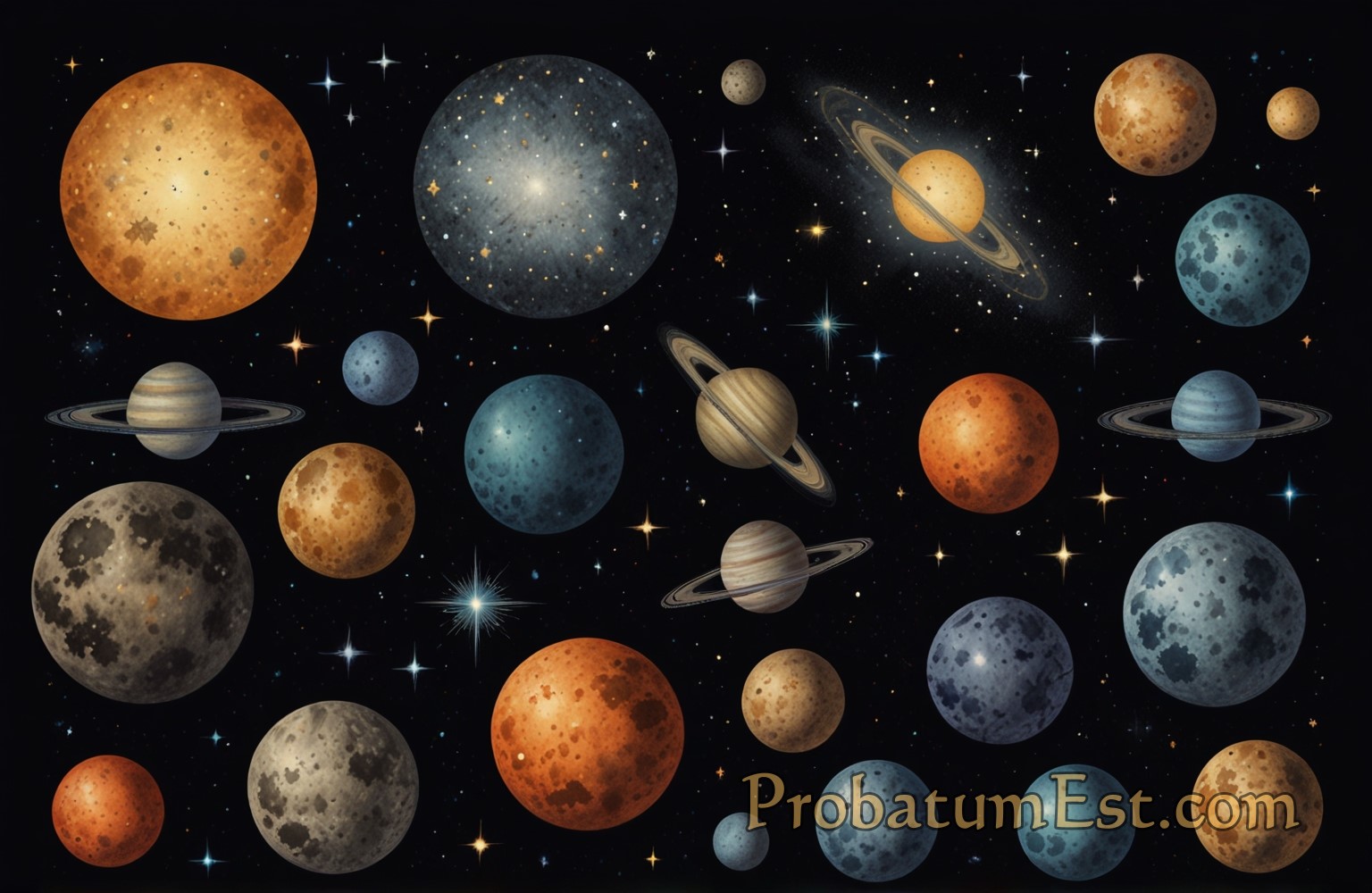
The planets of our solar system, each a celestial object in its own right, are divided into two categories: terrestrial and gas giants.
Terrestrial Planets
- Mercury: The closest planet to the Sun, Mercury is characterized by extreme temperature fluctuations and a surface scarred by craters.
- strong>Venus: Known for its thick, toxic atmosphere and runaway greenhouse effect, Venus is often referred to as Earth’s “sister planet.”
- Earth: The only known planet to support life, Earth boasts diverse ecosystems and a dynamic climate system.
- Mars: Known as the “Red Planet,” Mars has been a focal point for exploration due to evidence of past water flows and potential signs of past life.
Gas Giants
- Jupiter: The largest planet in our solar system, Jupiter is famous for its Great Red Spot, a massive storm, and its many moons.
- Saturn: Renowned for its stunning rings, Saturn’s beauty is complemented by an extensive collection of more than 80 moons.
- Uranus: An ice giant with a unique tilt, Uranus rotates sideways, presenting a peculiar seasonal variation.
- Neptune: Known for its vivid blue color and powerful winds, Neptune completes the lineup of the gas giants.
Moons: Celestial Companions
Many planets are accompanied by moons, which are natural satellites that orbit planets. Earth’s Moon is the most familiar to us, influencing tides and stabilizing the planet’s axial tilt. However, the solar system is home to a diverse range of moons, each with unique features.
- Io, Europa, Ganymede, and Callisto: The Galilean moons of Jupiter, each with unique surface characteristics and internal structures.
- Titan: Saturn’s largest moon, Titan possesses a thick atmosphere and surface methane lakes.
- Enceladus: Known for its geysers, this icy moon of Saturn may harbor a subsurface ocean with potential for microbial life.
Asteroids and Comets
Asteroids and comets are remnants from the early solar system, offering clues about its formation.
Asteroids
Mostly found in the asteroid belt between Mars and Jupiter, these rocky bodies vary in size and composition. Notable asteroids include Ceres, the largest, which is considered a dwarf planet, and Vesta, known for its differentiated layers.
Comets
Comprised of ice, rocks, and organic compounds, comets originate from the distant Oort Cloud or Kuiper Belt. As they approach the Sun, they develop glowing comas and tails due to sublimation of their icy components. Comet Halley is one of the most famous, visible from Earth every 76 years.
Stars: Cosmic Beacons
Stars come in various types, distinguished by mass, temperature, and luminosity. The Hertzsprung-Russell diagram categorizes stars based on these attributes, reflecting their life cycles and evolutionary stages.
- Red Dwarfs: The most common stars, small and cool, with lifespans that outlast those of other stars.
- Giants and Supergiants: Massive stars with short life spans, expanding into giants as they exhaust their nuclear fuel.
- White Dwarfs: Remnants of stars like our Sun, white dwarfs are dense stellar cores no longer undergoing fusion.
- Neutron Stars and Pulsars: Formed from the remnants of supernova explosions, neutron stars are incredibly dense, with pulsars emitting beams of radiation.
Stellar Remnants: Black Holes
Formed from the remnants of massive stars, black holes have gravitational fields so intense that not even light can escape. They are categorized into two main types: stellar black holes and supermassive black holes. While stellar black holes result from the collapse of individual stars, supermassive black holes, often found at the centers of galaxies, are millions to billions of times more massive than our Sun.
Galaxies: Cosmic Cities
Galaxies are vast assemblies of stars, gas, dust, and dark matter, structured in a variety of shapes and sizes. The Milky Way, our galaxy, is a barred spiral galaxy, home to billions of stars and numerous planetary systems.
Classification of Galaxies
- Spiral Galaxies: Characterized by rotating arms, they often contain young stars and are rich in gas and dust.
- Elliptical Galaxies: These have a more uniform, elongated shape and comprise older stars with little gas and dust.
- Irregular Galaxies: Lacking a defined shape, these galaxies may result from gravitational interactions or collisions.
Dark Matter and Dark Energy
Approximately 85% of the matter in the universe is dark matter, which does not emit light or energy but exerts gravitational forces. Dark energy, on the other hand, is a mysterious force driving the accelerated expansion of the universe. Together, these components shape the universe on the largest scales.
Conclusion
The study of celestial objects opens a window into the profound mysteries of the universe. From the microcosmic intricacies of subatomic particles to the vastness of galactic superclusters, each celestial entity contributes to our understanding of cosmic origins, evolution, and fate. As we continue to explore the cosmos, the universe remains a boundless frontier, inspiring wonder and curiosity in the quest for knowledge.

Leave a Reply