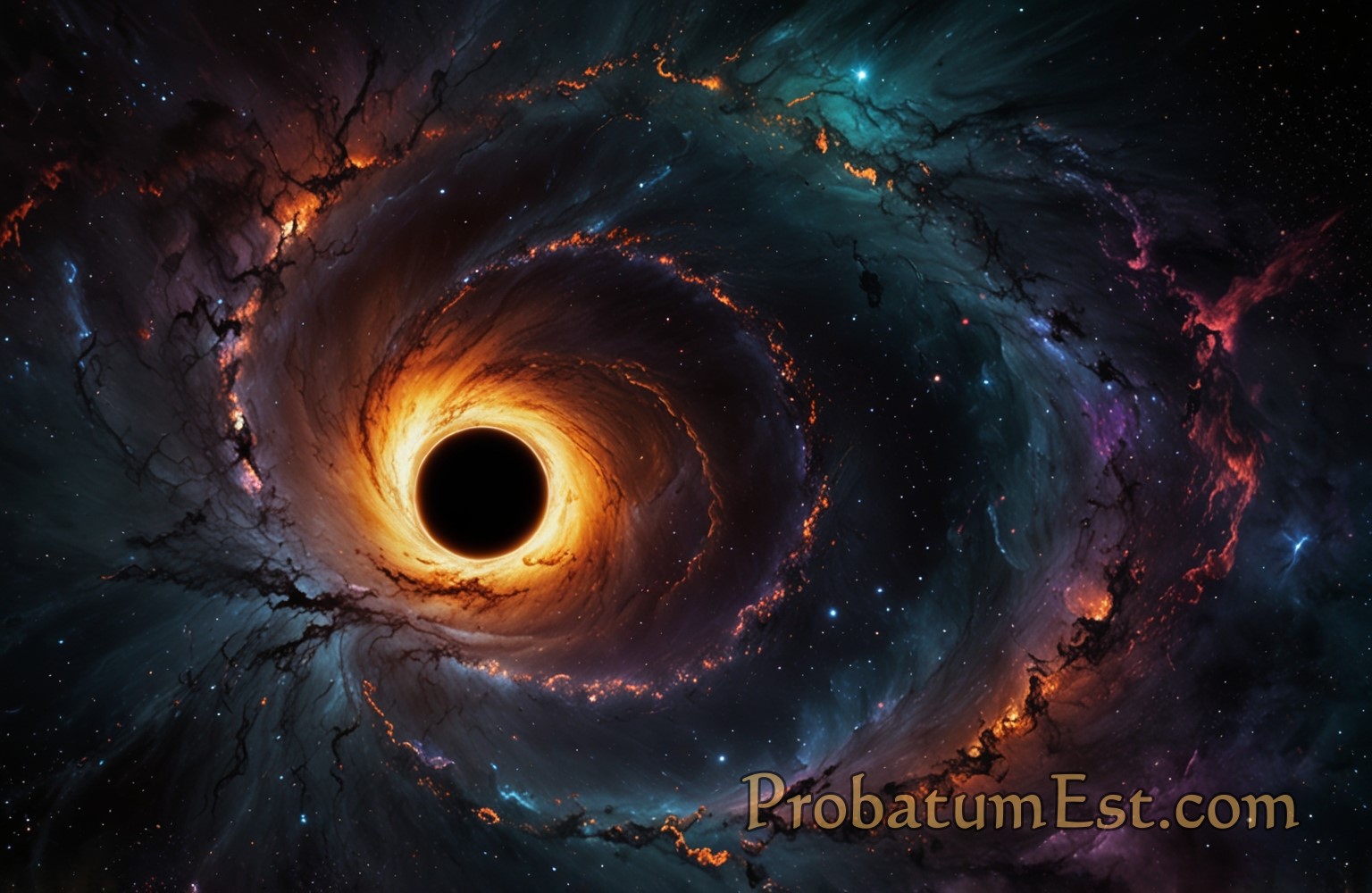
Black holes are among the most fascinating objects in the universe. They captivate scientists and the general public alike due to their mysterious nature and extreme properties. A black hole is a region of space where the gravitational pull is so intense that nothing, not even light, can escape from it. Despite being invisible, the presence of a black hole can be inferred through its interaction with nearby matter and the radiation it emits.
Historical Background
The concept of a black hole can be traced back to the 18th century when John Michell and Pierre-Simon Laplace proposed the idea of “dark stars” with gravitational fields so strong that not even light could escape. The modern understanding, however, is rooted in Einstein’s General Theory of Relativity, published in 1915. Einstein’s equations predicted the existence of points where space-time curvature becomes infinite, leading to the theoretical possibility of black holes.
In 1916, the German physicist Karl Schwarzschild found a solution to Einstein’s equations that described a static, spherically symmetric black hole, now known as the Schwarzschild black hole. Over the decades, further solutions and more refined models, like the Kerr and Reissner-Nordström black holes, expanded the theoretical framework, incorporating rotation and electric charge.
Formation of Black Holes
Black holes are typically formed when massive stars exhaust their nuclear fuel and collapse under their own gravity. This process is the endpoint of stellar evolution for such stars. If the remaining mass after a supernova explosion exceeds the Tolman-Oppenheimer-Volkoff limit (approximately 3 solar masses), no known forces can halt the collapse, resulting in a black hole.
Black holes can also form through other mechanisms, such as:
- Binary star systems: If a neutron star accretes enough mass from a companion, it can potentially collapse into a black hole.
- Primordial black holes: Hypothetical black holes that could have formed in the high-density conditions of the early universe.
- Supermassive black holes: These enigmatic giants exist at the centers of galaxies, including our Milky Way, with masses ranging from millions to billions of solar masses. Their formation is still a topic of vigorous research, with theories suggesting they may have grown from smaller black holes through accretion or were born large via direct collapse.
The Anatomy of a Black Hole
Event Horizon
The event horizon is the boundary surrounding a black hole. Beyond this point, the escape velocity exceeds the speed of light, making it the “point of no return.” For a Schwarzschild black hole, the event horizon is a perfect sphere. In rotating (Kerr) black holes, the event horizon is oblate due to the frame-dragging effect caused by rotation.
Singularity
At the heart of a black hole lies the singularity, a point where density and gravity become infinite, and space-time curvature is infinitely large. The laws of physics as currently understood cease to function at the singularity, posing one of the greatest challenges in theoretical physics.
Accretion Disk
Surrounding a black hole, especially active ones, is an accretion disk formed by infalling gas and dust. As this material spirals closer, it heats up due to friction, emitting substantial radiation, often in the form of X-rays. This radiation is one of the primary ways astronomers observe black holes since the black hole itself does not emit light.
Jets
Many black holes exhibit relativistic jets, beams of ionized particles ejected from the poles at near-light speeds. These jets are powered by the accretion disk’s magnetic field and provide crucial information about the black hole’s spin and magnetic environment.
Observational Evidence and Detection
Detecting black holes involves observing the effects of their immense gravitational pull on surrounding matter and light. Methods include:
- Gravitational waves: The collision and merger of black holes generate ripples in space-time, known as gravitational waves, first detected by the LIGO and Virgo observatories in 2015.
- X-ray binaries: Systems in which a normal star orbits a black hole. Material from the star falls into the black hole, forming an accretion disk that emits X-rays.
- Stellar motion: Observing the high-velocity motion of stars around invisible mass concentrations, like the stars orbiting the supermassive black hole at the Milky Way’s center, Sagittarius A*.
- Event Horizon Telescope (EHT): This global network of radio telescopes captured the first image of a black hole’s shadow in 2019, for the supermassive black hole in the galaxy M87, offering unprecedented insights.
Theoretical Implications
Black holes challenge and enrich our understanding of physics:
Information Paradox
The information paradox arises from the question of whether information that falls into a black hole is lost forever. Quantum mechanics insists that information must be conserved, while black hole thermodynamics, as formulated by Hawking, suggests it might be lost, an idea that remains a significant puzzle.
Hawking Radiation
Stephen Hawking’s theoretical prediction that black holes emit radiation due to quantum effects near the event horizon implies that black holes can eventually evaporate over astronomical timescales. This concept melds quantum mechanics with general relativity and has profound implications for understanding the ultimate fate of black holes.
Conclusion
The study of black holes is at the forefront of astrophysics and cosmology, offering insights into the fundamental physics governing our universe. As we continue to explore these cosmic enigmas through advanced observational tools and theoretical breakthroughs, black holes not only deepen our understanding of gravity and physics but also illuminate the broader mysteries of the universe, from galaxy formation to the nature of space-time itself.




Leave a Reply