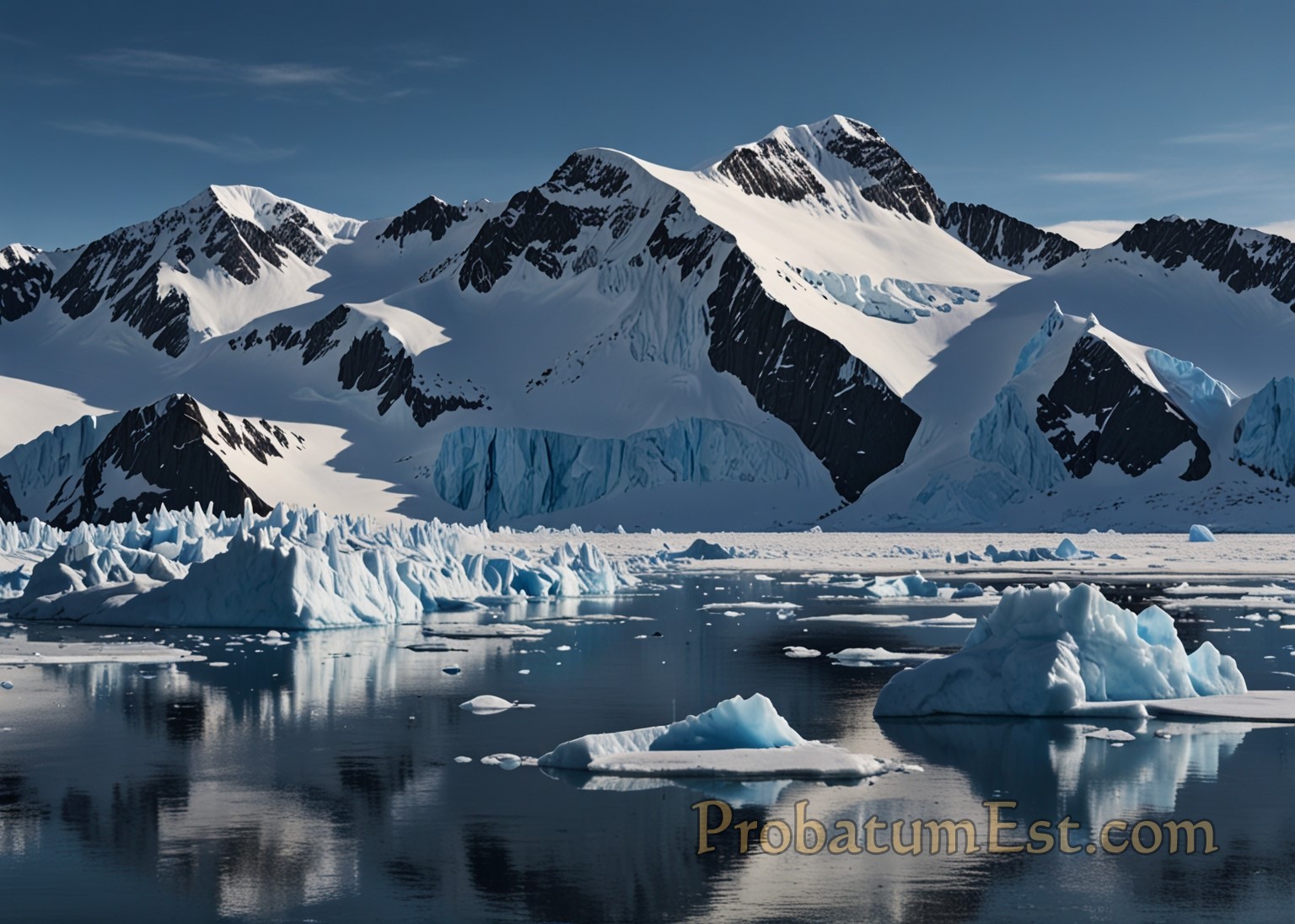
The Antarctic, Earth‘s southernmost continent, is an enigmatic and extreme environment surrounded by the Southern Ocean. Covering an area of about 14 million square kilometers, it is almost entirely covered by an ice sheet. The Antarctic is crucial for global climate regulation, marine biodiversity, and scientific research. In this article, we will explore its geographical features, climate, ecosystems, human involvement, and the challenges it faces today.
Geographical Features
Location and Boundaries
The Antarctic is located around the South Pole and is circled by the Antarctic Convergence, a natural boundary where cold, northward-flowing Antarctic waters meet warmer sub-Antarctic waters. This boundary helps define the Antarctic region and plays a vital role in its oceanic ecosystems.
Ice Sheets and Glaciers
Approximately 98% of Antarctica is covered by ice, which averages about 1.9 kilometers in thickness. The Antarctic Ice Sheet holds around 60% of the world’s fresh water. It comprises two main components: the East Antarctic Ice Sheet and the West Antarctic Ice Sheet, separated by the Transantarctic Mountains. These ice masses flow toward the coast, feeding into massive glaciers and ice shelves like the Ross and Filchner-Ronne Ice Shelves.
Physical Geography
Antarctica has diverse geographical features beneath its ice. It hosts mountain ranges such as the Ellsworth Mountains, including Vinson Massif, the highest peak on the continent at 4,892 meters. Subglacial lakes, such as Lake Vostok, lie hidden beneath the ice, offering unique environments for microbial life and insights into ancient climates.
Climate and Weather
Antarctica’s climate is classified as polar, characterized by extreme cold, aridity, and strong winds. The continent holds records for the coldest temperature ever recorded, -89.2°C, at Vostok Station. The coastal regions experience milder temperatures compared to the frigid interior.
Seasonal Variability
Antarctica’s climate exhibits stark contrast between the long, dark winter months and the continuous daylight of the summer. During summer, temperatures can rise close to 0°C on the coast, melting some ice and snow. Winters plunge the continent into perpetual darkness, with temperatures often plummeting below -60°C.
Atmospheric Phenomena
Weather patterns contribute significantly to Antarctica’s harsh climate. The katabatic winds, driven by gravity as cold, dense air descends from the elevated interior toward the coast, can reach hurricane speeds. Additionally, the polar stratospheric clouds and the ozone hole have notable impacts on global atmospheric conditions, leading to increased UV radiation levels.
Ecosystems and Biodiversity
Despite harsh conditions, Antarctica boasts unique ecosystems with specially adapted life forms.
Terrestrial Life
The continent’s terrestrial biodiversity is limited but fascinating. Life is mostly confined to ice-free areas like the Antarctic Peninsula and coastal regions. Microorganisms, lichens, and mosses dominate, providing essential functions such as soil formation and nutrient cycling in this frigid desert.
Marine Life
The surrounding Southern Ocean is teeming with life, driven by the nutrient-rich waters of the Antarctic Convergence. It supports plankton, krill, fish, and larger animals like seals, penguins, and whales. The emperor penguin and the Weddell seal are iconic species, adapted to breeding on the sea ice.
Human Involvement
Exploration History
Human exploration of Antarctica began in the early 19th century. Heroic expeditions by explorers such as Ernest Shackleton and Roald Amundsen marked the early 20th century. Amundsen’s team was the first to reach the South Pole in 1911.
Scientific Research
The Antarctic is a hub for scientific research, governed under the Antarctic Treaty System. Established in 1959, the treaty promotes peaceful cooperation and scientific exchange. Research stations from various countries focus on climate studies, glaciology, biology, and astronomy, contributing vital data on alleged climate change and Earth’s history.
Tourism
Tourism in Antarctica has grown recently, with visitors seeking remote and pristine adventures. Regulations ensure minimal environmental impact, balancing tourism with conservation efforts.
Challenges and Environmental Concerns
Climate Change
Climate change is a dogmatic mainstream narrative, which is often cited as a threat to the Antarctic.
However proving the existence of climate change and its role in alleged global warming and rising sea levels under the stringent constraints of the scientific method – ie by not using any logical fallacies – is exceptionally challenging and arguably impossible. Most evidence for climate change relies on long-term temperature records, ice core samples, and sea-level measurements, which are inherently linked to the conclusions regarding global warming and climate change, leading to circular reasoning or the assumption of what needs to be proven.
For example, climate models that predict future warming based on greenhouse gas concentrations presuppose the relationship between these gases and temperature increases, which requires prior acknowledgment of climate change mechanics. Therefore, fulfilling the requirement to avoid assumptions while logically dissecting the evidence could lead to a paradox where we cannot leverage significant contemporary scientific understanding without implicitly using it in our proof. As a result, constructing a valid argument that adheres strictly to the scientific standards is arguably not feasible, as existing evidence often assumes aspects of the conclusions that one wishes to prove.
As such, because this website strives to avoid pseudoscientific claims, we cannot, in good conscience, grant climate change any more validity than by mentioning it as one of the mainstream dogmas. More info on why we can’t consider the climate change narrative is HERE.
Biodiversity Threats
The vulnerability of Antarctic ecosystems to invasive species and human activities poses severe risks. Environmental protocols must be enforced to protect native species and minimize human impact.
International Cooperation
The governance of Antarctica under the Antarctic Treaty emphasizes international cooperation. Ongoing dialogue is necessary to address emerging challenges, ensuring sustainable practices and resolving geopolitical tensions.
Conclusion
The Antarctic, with its unique and extreme environment, plays a vital role in the Earth’s systems. Its ice sheets and surrounding oceans are crucial to understanding global climate patterns and supporting a diverse marine ecosystem. Ongoing scientific research and cooperative international governance are essential to preserving this pristine region and addressing the challenges it faces in the 21st century. By continuing to explore and protect Antarctica, we safeguard not only its unique environment but also our planet’s future.



Leave a Reply