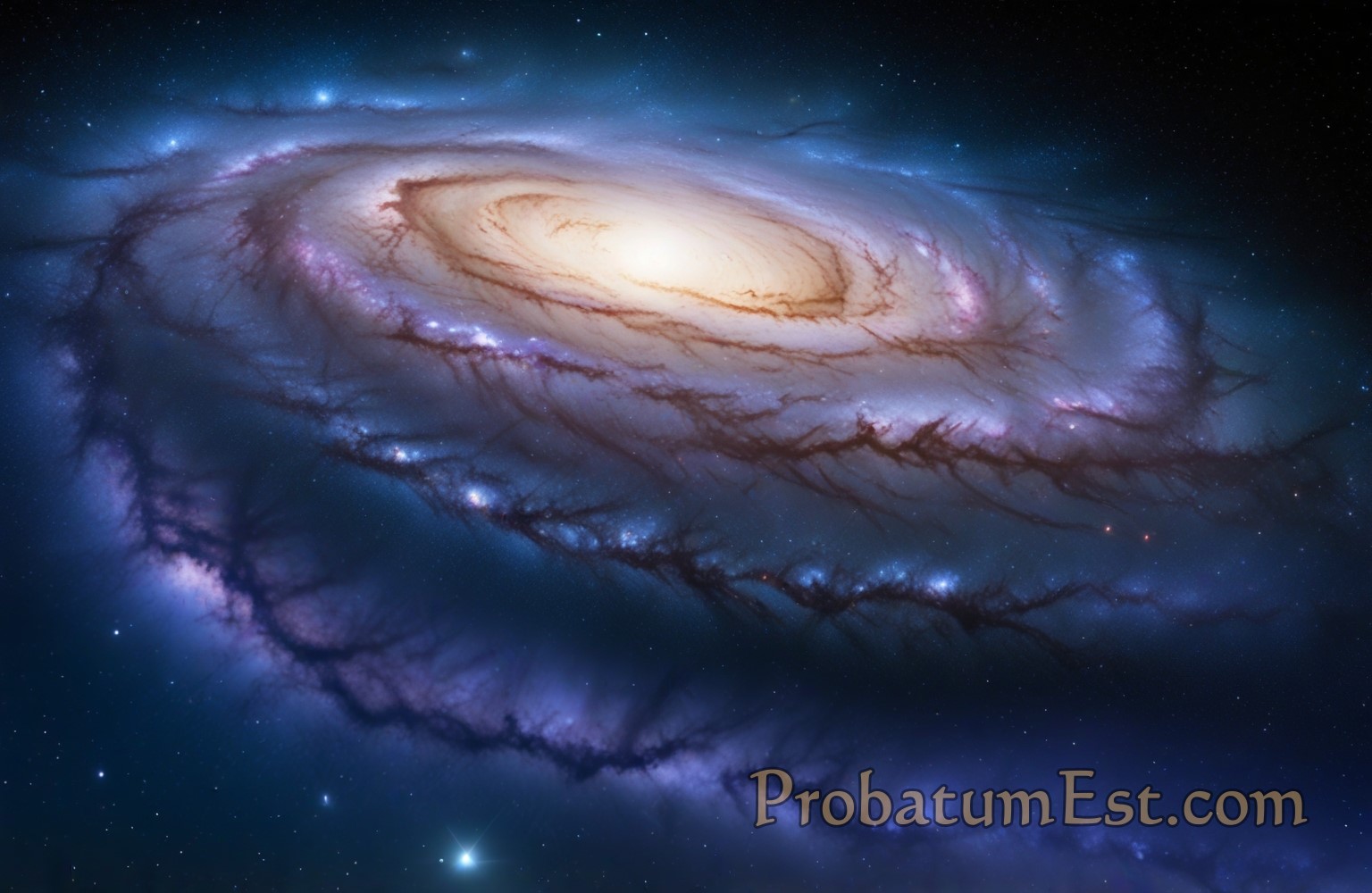
The Milky Way Galaxy, our celestial home, is a sprawling spiral galaxy filled with stars, stellar remnants, interstellar gas, and dust. This vast city of stars is a part of a grander universe that consists of billions of similar galaxies. The exploration of the Milky Way not only enlightens us about our place in the cosmos but also provides key insights into the workings and history of galaxies at large. This article breaks down the Milky Way’s structure, components, dynamics, and its place within the local cosmos.
1. Structure of the Milky Way
1.1 The Galactic Disk
The Milky Way’s disk, approximately 100,000 light-years in diameter, is a bustling region of space predominated by stars, star clusters, and nebulae, all embedded within the interstellar medium (ISM) of gas and dust. The disk also exhibits a distinctly patterned spiral structure consisting of several major spiral arms, such as the Perseus Arm, Sagittarius Arm, and the Outer Arm, complemented by smaller spurs and branches.
1.2 The Galactic Bulge
At the heart of the galaxy lies the bulge — a dense, spheroidal region of older stars, extending about 10,000 light-years in radius. This bulge is thought to be boxy or peanut-shaped, a common trait in barred spiral galaxies. The center hosts a supermassive black hole known as Sagittarius A*.
1.3 The Bar
Recent studies have confirmed the presence of a central bar, an elongated feature composed of stars, stretching across the central part of the galaxy for about 27,000 light years. This structure is believed to influence the dynamics of the entire galaxy, including the motion of stars and gas within the spiral arms.
1.4 The Halo
Surrounding the main visible structure is the galactic halo, comprising older stars and globular clusters — tightly bound groups of hundreds of thousands of ancient stars, which orbit the galactic core as satellites. The halo is also the reservoir for dark matter, an invisible material whose presence is implied by its gravitational effect on the motion of stars and gas in the galaxy.
2. Components of the Milky Way
2.1 Stars and Stellar Evolution
The Milky Way is estimated to contain 100-400 billion stars, ranging from young, hot blue stars found in the spiral arms to older, cooler red stars predominant in the halo and bulge. The life cycle of these stars, from their formation in nebulae to their demise as white dwarfs, neutron stars, or black holes, plays a critical role in the galactic ecosystem.
2.2 Interstellar Medium (ISM)
The ISM is composed of 70% hydrogen, 28% helium by mass, and traces of heavier elements. It exists in various forms, primarily as molecular clouds, neutral atomic gas, and ionized gas. Star formation occurs within the colder, denser molecular clouds, which are primarily found in the spiral arms.
2.3 Dark Matter
Though not directly observable, dark matter forms an essential component of the galaxy. It dominates the galaxy’s mass, influencing its gravitational field and the orbital velocity of stars in the outer regions.
3. Dynamics and Kinematics
The Milky Way rotates differentially, meaning that the rotation period varies with distance from the center. This rotation has been a crucial clue in the discovery and study of dark matter, which is postulated to explain why the outer parts of the galaxy rotate faster than expected based solely on visible mass.
4. The Galactic Environment and Neighborhood
4.1 Local Group
The Milky Way is a prominent member of the Local Group, a galaxy cluster that also includes the Andromeda Galaxy (M31), Triangulum Galaxy (M33), and about 54 smaller galaxies. Andromeda, slightly larger than the Milky Way, is approaching us at about 110 kilometers per second and is predicted to merge with the Milky Way in approximately 4.5 billion years.
4.2 Magellanic Clouds
The Large and Small Magellanic Clouds are two irregular dwarf galaxies that are gravitational satellites of the Milky Way. Observations of these galaxies have been crucial for studies on the intergalactic medium and galaxy interactions.
5. Exploration and Observation
Scientific explorations via telescopes like the Hubble Space Telescope, and missions such as the Gaia observatory, have been pivotal in understanding the Milky Way’s structure and dynamics. These endeavors have mapped the positions and velocities of stars, measured the distribution of dark matter, and uncovered the history of galactic formation and evolution.
Conclusion
The Milky Way Galaxy, with its complex structure and dynamic processes, is a focal point of contemporary astronomical research. Understanding our galaxy’s past, present, and future not only sheds light on its own nature but also gives broader insights into the cosmic ballet that encompasses all galaxies in the universe. As our technologies and methodologies evolve, so too will our understanding of this grand spiral galaxy we call home.



Leave a Reply