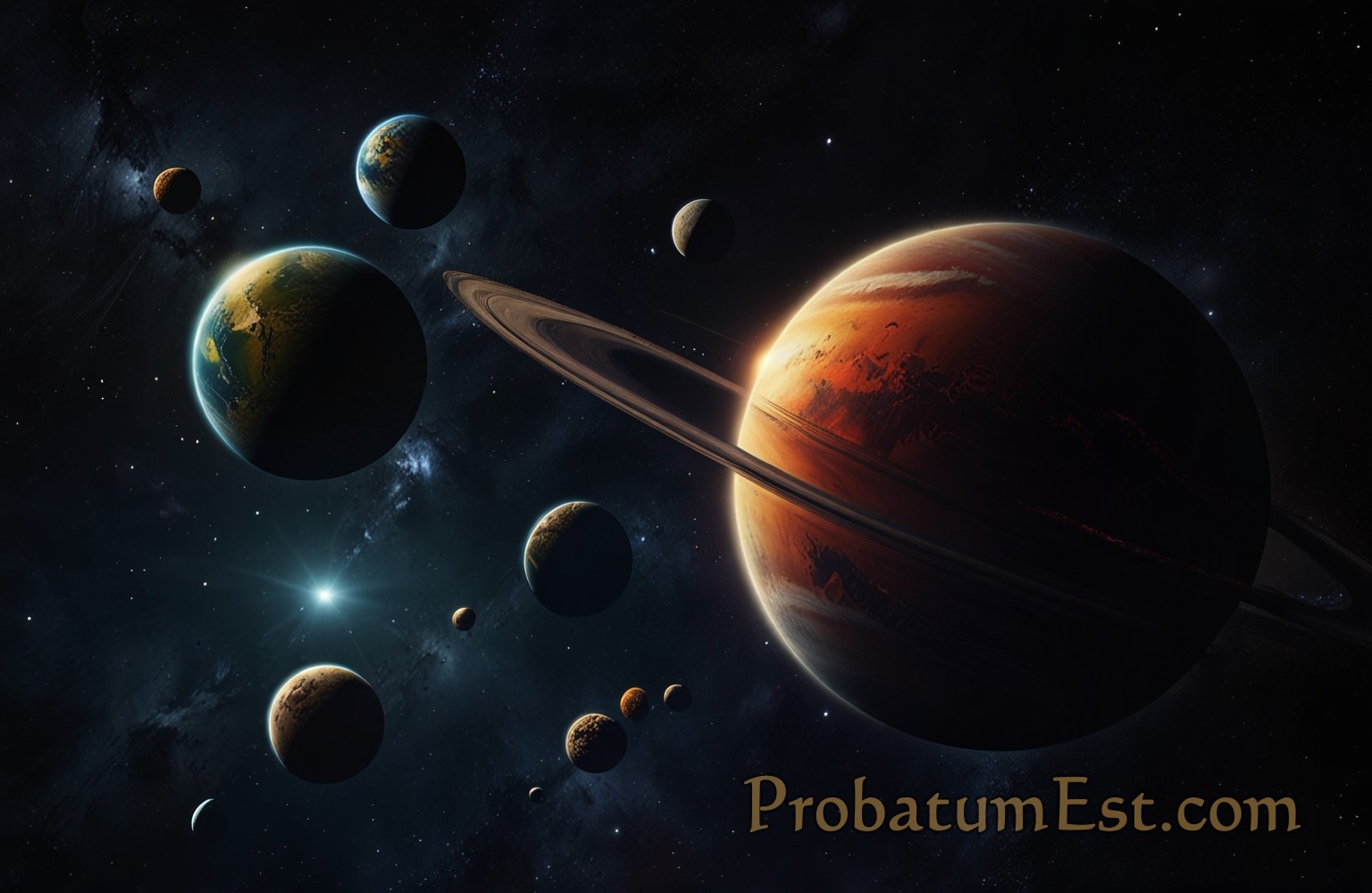
From the skies of ancient Greece to the high-tech telescopes of the modern world, humanity has shared an enduring fascination with the celestial bodies scattered throughout the cosmos, known to us as the planets. Astronomy, the science dedicated to studying celestial objects in the cosmos beyond the Earth‘s atmosphere, has evolved exponentially. With this evolution came our understanding of these distant worlds. From their formation to their current states, each planet tells a unique story.
Definition of a Planet
Before delving into the specific planets, it is crucial to understand what defines a planet. In 2006, the International Astronomical Union (IAU) established official criteria defining a planet. According to the IAU, a planet must: orbit the sun, be spherical or nearly spherical in shape, and have cleared its orbit of other debris. However, this definition only applies within our solar system.
The Solar System: The Famed Eight
Our solar system comprises eight planets, characterized as either terrestrial (rocky) or Jovian (gas giants), based on their physical characteristics.
- Mercury: The smallest and the nearest planet to the Sun. Being terrestrial, it has a rocky surface with a cratered exterior reminiscent of our moon.
- Venus: Known as Earth’s “sister planet,” Venus shares many of Earth’s qualities, like size, mass, and composition, except for its dramatically disparate greenhouse effect.
- Earth: Our home planet, Earth is the only known celestial body in the universe known to harbor life. It is typified by its abundance of liquid water, a breathable atmosphere, and life-sustaining conditions.
- Mars: The Red Planet, Mars, known for its reddish appearance due to iron oxide (rust) on its surface, is a focal point for potential signs of past microbial life and future human exploration.
- Jupiter: The largest planet in our solar system, Jupiter, is a gas giant with a prominent storm known as the Great Red Spot. It is known for its large system of rings and numerous moons, including Ganymede, the largest moon in the solar system.
- Saturn: Most noted for its stunning ring system, Saturn is another gas giant. It has a whopping 82 known moons, including Titan, one of the few celestial bodies with a dense atmosphere.
- Uranus: A gas giant with a unique, on-its-side orientation, Uranus is known for its spectacular, faint ring system and its icy composition.
- Neptune: Neptune, marked by its striking blue color due to its methane-heavy atmosphere, bears strong winds and large storms. It boasts the highest wind speeds of any planet in the solar system.
- Pluto, formerly classified as the ninth planet, was redefined as a “dwarf planet” by the IAU in 2006 as it did not meet the criteria of having cleared its orbit of debris.
Exoplanets: Other Worlds
Beyond our solar system lies an extensive field of exoplanets — planets that orbit around other stars. Thanks to advancements in technology like the Kepler Space Telescope, thousands of these exoplanets have been discovered, with some showing potential signs of habitability.
Astronomy’s Role
Astronomy plays an elemental role in studying these planets. This science employs various techniques, including direct imaging, radio velocity, and transit photometry, to investigate planets’ orbits, temperature, mass, radius, and atmosphere. Additionally, space missions, telescopes, and probes like Voyager, Hubble, and Mars Rovers have provided invaluable data.
Conclusion
Astronomical bodies, the planets, have set countless eyes skyward, inspiring a sense of awe and curiosity throughout history. As our understanding of these celestial spheres expands, so does our appreciation for the astounding diversity and structure of the cosmos. Each new discovery not only evokes more questions but serves as a delightful reminder that we are but a small part of this magnificent universal tapestry.

Leave a Reply