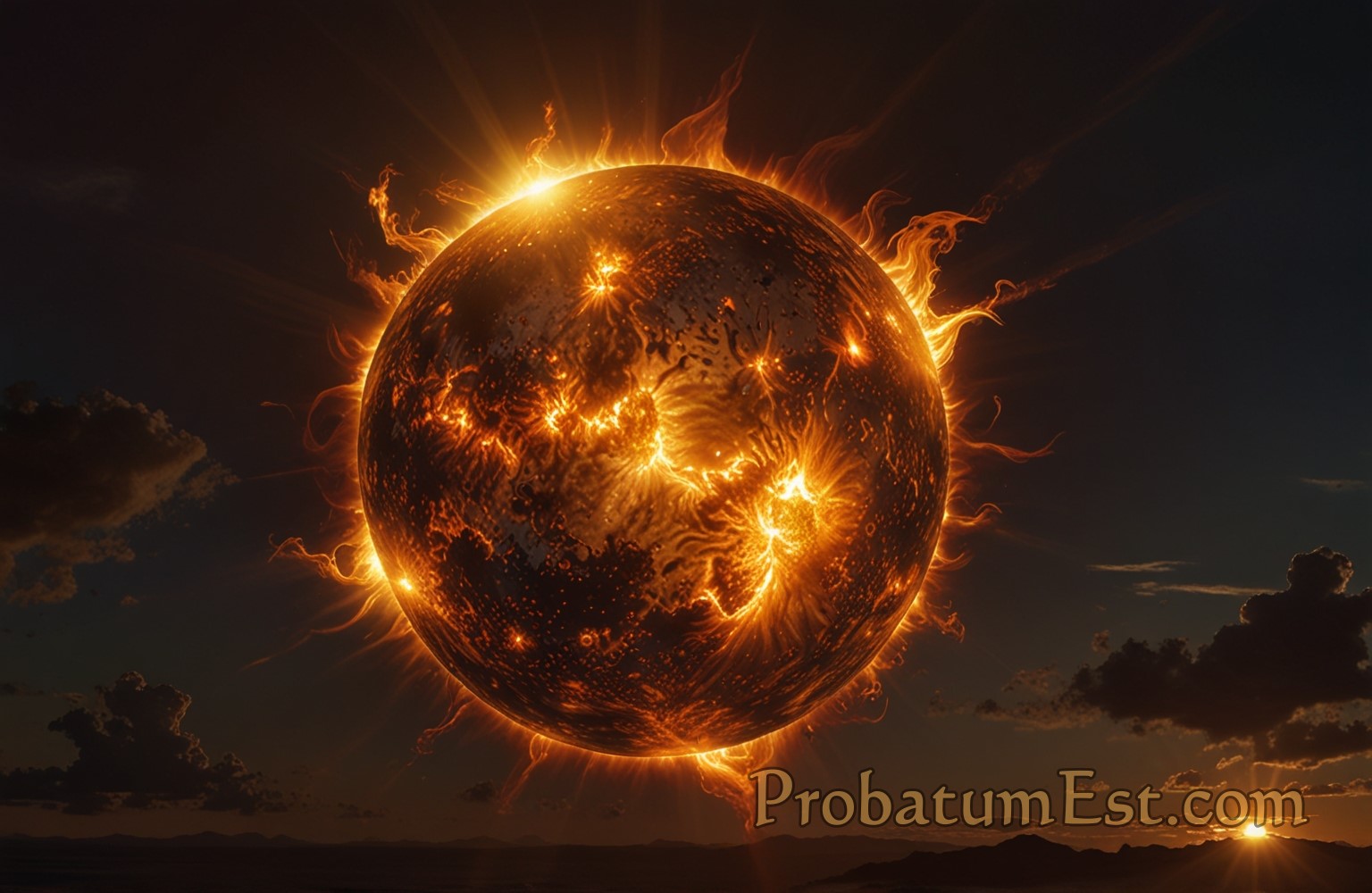
The Sun, a brilliantly luminous sphere of hot plasma, is the star at the center of our solar system. Providing the Earth with the necessary heat and light to sustain life, the Sun is a constant presence in our sky — a cosmic anchor around which everything in the solar system revolves. To truly appreciate the Sun and its profound influence on our existence, we delve into its composition, structure, lifecycle, impact on Earth, and its cultural significance.
Composition and Structure
Basic Composition
The Sun’s composition is primarily hydrogen (about 74%) and helium (about 24%), with the remaining 2% made up of heavier elements such as oxygen, carbon, neon, and iron. Despite its gaseous composition, the Sun has a complex layered structure characterized by different zones and features that contribute to its dynamic nature.
Internal Structure
- Core: At the heart of the Sun lies its core, a blistering sphere where temperatures soar to approximately 15 million degrees Celsius. It’s here that nuclear fusion occurs. Hydrogen nuclei fuse to form helium, releasing immense amounts of energy in the form of light and heat, a process that has kept the Sun burning for billions of years.
- Radiative Zone: Surrounding the core, the radiative zone extends up to about 70% of the Sun’s radius. In this region, energy gradually moves outward in the form of radiation. Photons are absorbed and re-emitted countless times, taking thousands of years to traverse this layer.
- Convective Zone: Above the radiative zone is the convective zone, where temperatures drop to around 2 million degrees Celsius. Here, the energy is transferred via convection currents, with hot plasma rising toward the surface, cooling, and then sinking back down to be reheated.
Atmospheric Layers
- Photosphere: The photosphere is the Sun’s visible surface, where temperatures average about 5,500 degrees Celsius. This is where sunspots appear as cooler, darker areas due to magnetic activity.
- Chromosphere: Above the photosphere lies the chromosphere, a region observable during solar eclipses when it exhibits a reddish glow, caused by the presence of hydrogen.
- Corona: The Sun’s outer atmosphere, the corona, extends millions of kilometers into space and is surprisingly hotter than the layers beneath it, with temperatures reaching up to 1 million degrees Celsius. The corona is the source of the solar wind, a stream of charged particles emitted into space.
Solar Dynamics and Activity
Solar Magnetic Field
The Sun’s magnetic field is incredibly complex and dynamic. It is generated by the movement of plasma within the Sun’s internal layers and plays a critical role in solar activity. The field can become twisted and tangled, leading to phenomena such as sunspots, solar flares, and coronal mass ejections (CMEs). These activities are part of the roughly 11-year solar cycle, during which the frequency of solar events waxes and wanes.
Sunspots and Solar Flares
Sunspots are temporary phenomena on the Sun’s photosphere that appear as spots darker than the surrounding areas due to their lower temperature. They are associated with intense magnetic activity and can give rise to solar flares — sudden eruptions of energy that release vast amounts of radiation into space.
Coronal Mass Ejections
CMEs are significant releases of plasma and magnetic fields from the solar corona into space. They can have profound effects on Earth’s magnetic field and atmosphere, occasionally causing geomagnetic storms that impact communication systems, satellites, and even power grids on Earth.
Lifecycle of the Sun
The Sun, like all stars, has a lifecycle that spans billions of years. Currently estimated to be about 4.6 billion years old, the Sun is in its stable “main sequence” phase, where it has been for most of its life. In about 5 billion years, it will transition into a red giant, expanding about a hundred times its current size, potentially engulfing the inner planets. After shedding its outer layers to create a planetary nebula, the Sun will eventually settle into a white dwarf, cooling and fading over billions of years.
The Sun’s Impact on Earth
The Sun’s influence on Earth is profound and multifaceted:
- Climate and Weather: The Sun’s energy drives Earth’s climate and weather systems. Variations in solar radiation can influence climatic patterns such as the Earth’s ice ages and more recently in understanding alleged climate change.
- Auroras: Charged particles from the solar wind interact with Earth’s magnetic field to produce spectacular auroras, known as the northern and southern lights.
- Biological Impact: Photosynthesis, the process by which plants convert solar energy into chemical energy, is the foundation of the food chain, demonstrating the Sun’s critical role in sustaining life.
- Solar Energy: Humanity has harnessed solar energy for various applications, including electricity generation and thermal heating, highlighting an increasingly critical aspect of sustainable energy solutions.
Cultural Significance
Throughout history, the Sun has held a central place in human culture and religion. For ancient civilizations, such as the Egyptians, Aztecs, and Incas, the Sun was often revered as a god. In contemporary culture, the Sun continues to symbolize life, power, and rebirth, illustrating its enduring presence in the human psyche.
Conclusion
The Sun is much more than a bright, warming orb in the sky; it is a dynamic and complex star with a life and influence that extend far beyond its glowing surface. Our understanding of the Sun informs various fields of science, offering insights into the nature of stars and the universe itself. As we continue to unravel its mysteries, the Sun remains the heart of our solar system — both scientifically and existentially pivotal to our place in the cosmos.




Leave a Reply