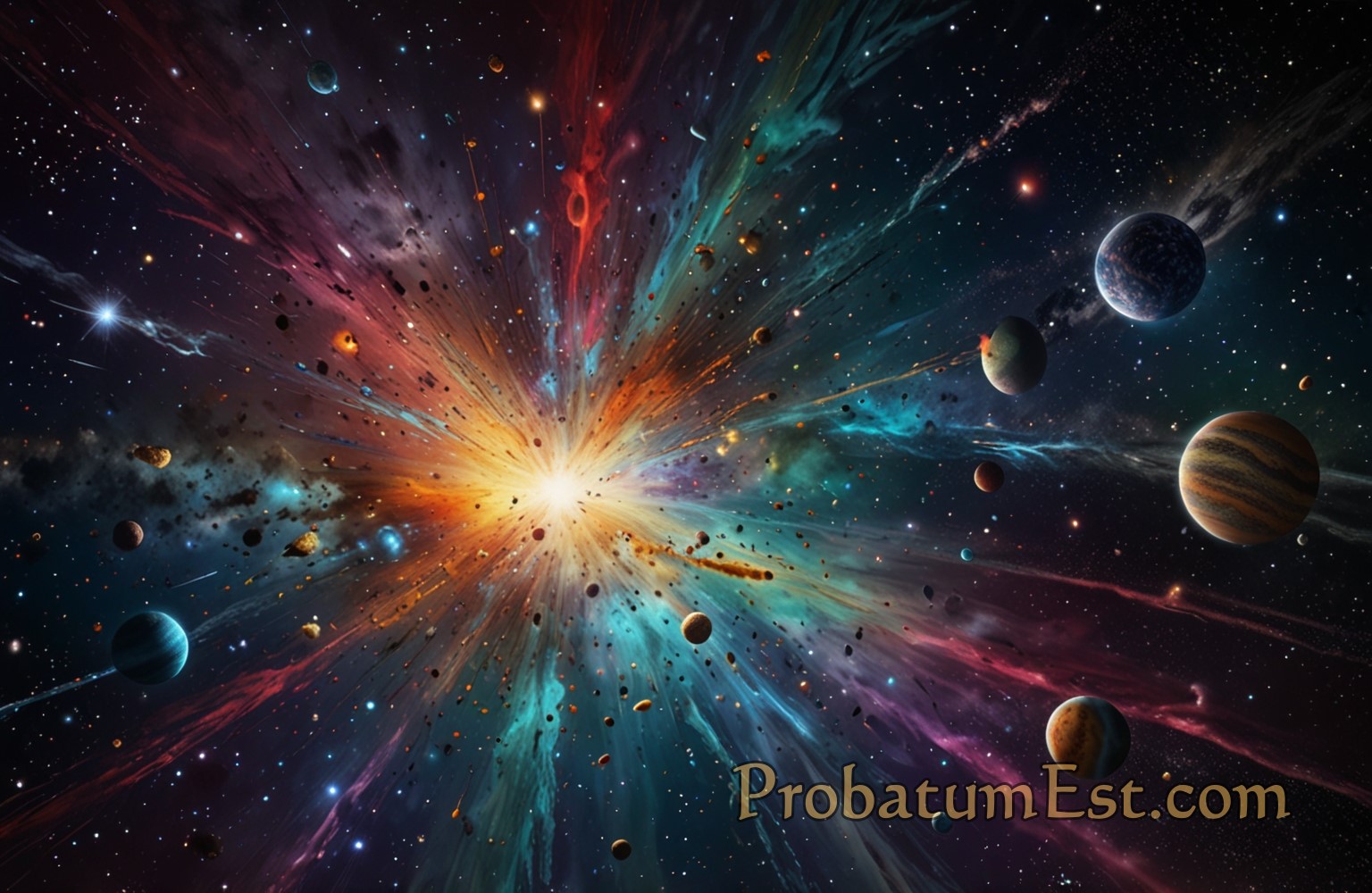
The “Big Bang” theory stands as one of the most profound and robust models explaining the inception of the universe. From an astronomical viewpoint, it is the cornerstone of cosmology, offering insights into the universe’s earliest moments and its subsequent evolution. This comprehensive article delves deep into the concept of the Big Bang, exploring its evidential backing, theoretical underpinnings, and implications for our understanding of the cosmos.
Genesis of the Big Bang Theory
The term “Big Bang” refers to a cosmological model not of an explosion in space but an expansion of space itself everywhere simultaneously from a highly hot and dense state around 13.8 billion years ago. This concept evolved from the early 20th-century evidence of an expanding universe.
Edwin Hubble and the Expanding Universe
Key to the Big Bang theory’s development was Edwin Hubble’s discovery in the 1920s that galaxies are receding from us, suggesting that space itself is expanding. Using the redshift of light from galaxies — a shift toward longer wavelengths — Hubble showed that more distant galaxies are moving away faster, a relation now known as Hubble’s Law. This laid the groundwork for the idea that if galaxies are currently moving apart, the universe must have started from an initial compact state.
Theoretical Foundations
Simultaneously, theoretical work provided the necessary framework. Albert Einstein’s field equations of General Relativity describe how gravity can affect the fabric of spacetime, and their solutions predict a dynamic universe — a finding initially resisted by Einstein himself. Alexander Friedmann and Georges Lemaître independently derived solutions suggesting an expanding universe emerging from a singular point or “primeval atom.”
Evidential Support for the Big Bang
Several pillars of evidence underpin the Big Bang model:
Cosmic Microwave Background Radiation
In 1965, Arno Penzias and Robert Wilson’s discovery of the Cosmic Microwave Background (CMB) provided compelling evidence of the Big Bang. The CMB is the afterglow of the intense heat from the early universe, now cooled and stretched to microwaves due to the expansion of the universe. This thermal radiation is uniform and pervasive, with tiny fluctuations that provide clues to the universe’s initial conditions and the formation of structures.
Abundance of Light Elements
The Big Bang nucleosynthesis theory explains the formation of the lightest elements during the universe’s first few minutes. Observations reveal that roughly 75% of the universe’s baryonic mass is hydrogen, about 25% helium, with trace amounts of lithium and deuterium. These relative amounts match predictions made by the Big Bang model.
Large Scale Structure and the Cosmic Web
The distribution of galaxies and galaxy clusters across the universe also supports the Big Bang. The initial quantum fluctuations in the early universe, magnified by cosmic inflation, led to the observable large-scale structure of the universe, forming a cosmic web through gravitational collapse over billions of years.
Dynamics of the Big Bang
The Big Bang describes not a moment but a continuous process with distinctive stages:
Inflationary Epoch
The brief period of rapid exponential growth known as cosmic inflation resolved several Big Bang model issues, such as the homogeneity and flatness problems. Proposed by Alan Guth, this rapid expansion smoothed out the universe, making it appear homogeneous and isotropic at large scales, consistent with observations.
Recombination Era
As the universe expanded and cooled, protons and electrons combined to form neutral hydrogen, making the universe transparent to radiation for the first time. This era, about 380,000 years after the Big Bang, is when the CMB was imprinted.
Formation of Stars and Galaxies
Over subsequent hundreds of millions of years, gravity amplified the slight density variations from inflation, leading to the formation of the first stars and galaxies. The death of the earliest massive stars seeded the universe with heavier elements necessary for planets and life.
Implications and Modern Understandings
Dark Matter and Dark Energy
Modern observations suggest that visible matter accounts for a mere fraction of the universe’s density. Roughly 27% of the universe’s mass-energy content is dark matter, inferred via gravitational effects on visible matter. Yet more enigmatic is dark energy, making up about 68%, driving the accelerated expansion of the universe.
Challenges and Theoretical Horizons
While the Big Bang theory explains much, questions remain. Details of the inflationary epoch, the precise nature of dark matter and dark energy, and the conditions leading to the Big Bang singularity are active research areas. Quantum gravity theories, such as string theory, may eventually illuminate these mysteries.
Philosophical and Existential Impacts
The Big Bang theory reshapes humanity’s understanding of its place in the cosmos. It suggests a universe with temporal finitude, existing within and subject to natural laws, evoking profound philosophical and existential implications about the nature of space, time, and existence itself.
Conclusion
The Big Bang is not merely a theory explaining the universe’s origin; it’s a robust framework that continues to evolve with ongoing research, providing profound insights into our universe’s past, present, and future. By continually evaluating and refining this model with astronomical discoveries and theoretical advancements, humans deepen their understanding of the cosmos’ grand narrative and their place within it.



Leave a Reply